Were You a Needy Child? There is No Such Thing

-Jonice Webb, PhD

My mother has complained about my behavior as a child for YEARS. When I was little, she says I “always wanted to be held,” and was “so dramatic” as a teen, acting out to get attention. I was nearly held back in Kindergarten for lack of social skills; I hadn’t been around children my age regularly until then. In occasional situations with peers, she reports that I clung to the wall.

She was faithful to pass along my father’s criticisms, because he rarely spoke. He had no friends and didn’t participate in social activities. He was hospitalized this January, and my mother didn’t even tell me! He passed away 3 weeks after I found out he was sick. I have no tears; I barely knew him. He hasn’t been gone 6 months and the house I grew up in is already on the market.

Perhaps they assumed that if their kids were fed, clothed, sheltered, and in school, their work was done. My mother said once that it never occurred to her that she should be teaching her children to take care of themselves. We were her job.

I’ve struggled for over 50 years to find my strengths, and am scared and frustrated to be without a career (or job) at an age when most people are preparing for retirement.

———————————————-

Dear Anon,

Reading your mother’s description of you as a child breaks my heart. She thought you were excessively needy. I can, without even knowing you, say with 100% certainty, that you were not needy or poorly behaved.

You were emotionally starving.

In reality, there is no such thing as a needy child. All children are emotionally needy by definition. It is the parents’ responsibility to try their best to understand what their child needs and to try their best to provide it. Whether it be structure, limits, freedom of expression, emotional validation or social skills, it’s all part of the job.

Growing up emotionally ignored results in growing up with a tendency to ignore yourself. When you ignore yourself, you don’t have a chance to truly know yourself. What career should you be in? What kind of job would you excel at and enjoy? Not knowing yourself makes you feel lost, alone and at sea. The answers are there inside of you, but you were not taught how to find them.

Many parents (yours included) don’t realize that their job is not simply to provide for their children and raise them; they’re also supposed to respond to their children’s emotions. Wanting to be held is a healthy and normal requirement that all children have. “Drama” is nothing other than a judgmental word for emotions. Teenagers act out when they’re either over-controlled or under-attended to by their parents.

How can you know yourself when your parents never knew you? How can you feel that you’re lovable when you didn’t feel love from those who brought you into this world and are supposed to love you first and best?

Fortunately, dear Anon, you can still get where you want to be! Accept that you are worth knowing, and start giving yourself the attention you didn’t get as a child. Notice what you like, love, hate, enjoy, prefer, and need. Start noticing what you feel, and start using those feelings to guide and connect you.

If you haven’t yet read Running on Empty, please do so as soon as you can. If you don’t have a therapist, please consider finding one. The social and emotional skills you missed can be learned. You are a classic example of Childhood Emotional Neglect. And you can heal.


People Get So Immersed in Their Children’s Happiness That They Lose Sight of Their Own

Gretchen Rubin

Happiness interview: Caren Osten Gerszberg.

I got to know Caren a few years ago through a mutual friend. She’s a writer who covers travel, education, and is also a co-founder of the site Drinking Diaries (“from celebration to revelation”), along with Leah Odze Epstein. They just co-edited a thought-provoking anthology, Drinking Diaries: Women Serve Their Stories Straight Up.

Caren writes often about issues that touch on the subject of happiness, so I was interested to hear what she had to say.

Gretchen: What’s a simple activity that consistently makes you happier?

Caren: Reading by the fireplace. Playing Scrabble with my kids. Waking up before dawn to catch an airplane. Watching a movie in bed. Spending Friday night dinner with my family. Hiking with my two dogs and watching them lope through the woods. Rock climbing to a point where I can look at a vista and let it seep in. Taking evening walks with my husband to the Long Island Sound, where we look at the water in the moonlight. Settling in to shavsna, or “corpse pose,” after a good yoga class. Typing the last word of an article I’m writing.

What’s something you know now about happiness that you didn’t know when you were 18 years old?

When I was 18, happiness amounted to a sensation. It was deep, but fleeting, and involved a thrill with friends or a fun happening with my very fun parents. Now, when I’m happy, I feel it down to my core, mostly when I’m with my husband and children. It’s been 30 years since I was 18—I’ve lost my father and one of my childhood friends to cancer, and my mother suffers from mental illness. There is nothing I take for granted. Happiness is a blessing and I appreciate it profoundly whenever I feel it.

Is there anything you find yourself doing repeatedly that gets in the way of your happiness?

Yes. I grew up surrounded by anger and stress, which took up a life of their own in my life, and thus in my head. As cliché as it sounds, sweating the small stuff used to interfere with my path to happiness on a frequent basis. In recent years, I’ve learned how to meditate, breathe deeply, and be more accepting of myself and others, which has afforded me greater access to happiness. I’m no expert, but feeling the positive impact inspires me to continue the journey.

If you’re feeling blue, how do you give yourself a happiness boost?

It took me many years to accept that it’s okay to feel blue. As a kid, I felt responsible for my mother’s happiness, which weighed heavily on my own. But I’ve learned over the years that it’s okay to have bad days, because that’s how you learn to appreciate the good ones. So when I’m feeling blue, I seek comfort from within, reminding myself that it’s okay to feel blue and that hopefully, tomorrow will be a better day. And usually, it is.

Is there anything that you see people around you doing or saying that adds a lot to their happiness, or detracts a lot from their happiness?

In our society, and particularly in the community in which we live, I often see people getting so immersed and involved in their children’s happiness, that they seem to lose sight of their own. When I became a mother, nearly 19 years ago, I was deeply fearful of losing my identity as an individual. It was not easy to obtain a balance, but I knew that I needed to feel productive and invested in my own self-worth in order to be the kind of mother I wanted to be. Fortunately, but not without bumps in the road, there is balance in my life. I am a mother, a wife, a daughter, a writer, and a friend, and feel comfortable and happy in all of my roles.

Is there some aspect of your home that makes you particularly happy?

As much as people think I’m a social person, I also love being at home. I love reading and soaking in the bathtub by candlelight, spending time by the fireplace in our living room, and feel very happy when I’m cooking in our kitchen. There was a time when I felt irritated by the hubbub surrounding the kitchen space every afternoon, with my kids shouting at one another and fighting over this and that. But ever since my father got sick and passed away, I realize the value of that noise. Those sounds—now music to my ears—mean that my family is alive and interacting, and minus the fighting, I wouldn’t want it any other way.

3 Types of Parents Who Get Bullied By Their Own Children

…and some expert advice on stopping the cycle.

Susan Newman, PhD

Parents often make excuses for their children’s outrageous behavior, whether it’s a preschooler’s tantrum or a teen’s sullen refusal to do what he or she has been asked. Children who become unmanageable or verbally abusive to their parents are, in fact, bullies, although most parents don’t think of these behaviors in that way.

Maybe they should.

Sean Grover, a New York psychotherapist, mustered the courage to call such children exactly what they are—bullies—and figured out how frustrated parents can take charge again and restore positive parent-child relationships.

Here’s what he had to say:

Sean, you have worked with children and parents for more than 20 years. What prompted you to write, When Kids Call the Shots: How to Seize Control from Your Darling Bully—and Enjoy Being a Parent Again?

Grover: Years ago, when I started to feel I was being bullied by my own child, I read every parenting book I could get my hands on. I found a lot of generic advice that doesn’t fit all parents, or quick solutions that didn’t last.

I realized that parenting books rarely address a parent’s unique history, culture, and parenting style. When I stopped trying to fix or change my child, and explored my own role in fostering her bullying behaviors, I found the answers I needed. Her behaviors were a direct consequence of my own insecurities.

The greatest impact on how we parent is our personal history. It amazed me how few parenting books took that into account. Obviously, I can’t provide therapy to all the parents who are being bullied by kids. So in the book, I use worksheets, journaling, and insight-oriented exercises to help parents understand their history and discover how it affects their parenting choices.

When we think of bullying, most of us couple the word with “school.” We worry about our children being bullied in a school setting. How does a parent recognize that they have a bully in the house?

Grover: The collision course between parents and children is nothing new. All children go through test periods. Parents are always in the position of making unpopular decisions and saying no to things kids want to do.

When a child tests a parent’s authority and the parent sets a limit, the child learns to control himself. Setting limits and boundaries is essential to a child’s healthy emotional development. When those limits and boundaries aren’t set clearly, you’ll soon find yourself at a tipping point for bullying.

Testing can be described as nagging and pestering. Bullying, on the other hand, is aggressive, hostile, and mean. It involves verbal assaults, physical aggression, putdowns, and unrelenting abuse. And it feels terrible.

The bullies in the schoolyard are no different from the child bullying her parent at home: Both will stop at nothing to get what they want. They lack empathy and are trapped in their own narcissism. They will threaten, blackmail, and terrorize you until you give in. Until they are taught limits and boundaries, the parent-child relationship is doomed.

The question most parents ask when their child of any age rebels or become difficult is: What happened to my sweet, affectionate, obedient child? How does pushing the limits and seeking independence cross the line to bullying?

Grover: Never let your kid disrespect you. Never let your kid talk down to you. Establish a culture of mutual respect in your family. Help your kid to express frustration constructively. Children have more feelings than words, so they need strong leadership from their parents to learn how to express themselves in words effectively and use frustration as fuel for personal growth.

A little bit of defiance is expected in children. It’s how they learn to be assertive and establish a solid sense of self and identity. You don’t want your kid being too cooperative or too accommodating. He or she will become a pushover or a target for bullies, and is more likely to suffer from anxiety or depression.

What immediate steps can a parent take when immersed in a standoff with their child?

Grover: Bullying is a symptom of an unbalanced inner life. When your kids act up, ask yourself: What’s really going on here? Are they tired? Are they hungry? Are they frightened? Perhaps they are having social difficulties at school or suffering from undiagnosed learning problems that create much psychic tension and devastate self-esteem. Try to locate the source of their anxiety, then address it directly.

In heated moments, don’t become reactive. Hit the pause button. Maintain your leadership and never bully back. If you bully back you are establishing a bullying culture in your family.

When to comes to raising children, modeling is king. I’ve heard it said that children absorb 10% of what you say and 90% of what you do. If you’re losing your patience, yelling, and threatening, you’re going to eventually be on the receiving end of that behavior from your kids. You may not see it when they are young, but as they get bigger and feel more powerful, it will resurface with a vengeance.

Why do parents give in to bullying from a child?

Grover: The true cause springs from parents’ own histories—how they were parented, their childhood experiences, and the modeling that their parents provided. These are the true causes. Were they bullied as children by their own parents? Did they grow up with an absent or neglectful parent? Did they have a narcissistic parent? These are questions parents want to explore.

I also look at what’s going on in parents’ lives: Are they in an unhappy relationship? Does their partner have a different parenting style? Are they suffering parent burnout? It’s hard to parent well under those conditions.

Self-care and child care go hand in hand. Often the best way to turn a bullying situation around at home begins with taking better care of yourself.

Three parenting styles are most likely to trigger bullying in children.

The guilty parent. Something has gone wrong—a divorce, an illness, a financial hardship—and now the parent feels guilty. To ease their guilt they give their kids too much freedom and not enough limits. This always backfires.
The anxious parent. This is a parent who is always worrying and expressing anxiety. Children experience a parent’s anxiety as, “I don’t believe in you,” “I don’t trust you,” or “you’re not a capable person,” and this triggers a lot of anger and resentment toward the parent.
The fix-everything parent. These parents can’t stand to see their children frustrated and constantly step in and solve problems for them. Such parents have good intentions and are often heroic, but the outcome is horrendous. The child remains dependent on the parents and unconsciously resents them for it. They are never satisfied. In fact, the more you give them, the less they appreciate you. Children have a natural drive for independence that needs to be encouraged. The fix-everything parent discourages it and therefore dwarfs the emotional development of their own child. Children of fix-everything parents have a tendency to age but not mature.

In your book you provide a training ground for new skills and a road back to sanity for parents bullied by their kids. What can parents do to counter the bullying and reverse patterns that may already be set?

Grover: Parents committed to working on themselves rarely fall victim to continued bullying. Mindfulness is not a word often associated with parenting. Neither is self-mastery. But without either it’s impossible to have a healthy relationship with your child. Parenting will always be an emotional and psychological workout.

After exploring your personal history and exposing the fears and insecurities that foster bullying in your child, make a concrete plan of action that begins with assembling an anti-bullying support team. Too often, bullied parents are ashamed of the situation. Breaking the silence and involving others for support is crucial.

Make sure you and your partner are united. Conflicting parenting styles are often at the heart of behavior problems at home.

Enlist friends and family. Children respond positively to adults other than their parents when these behaviors are confronted. Look for models and mentors in adults that your children look up to.

Involve school officials. Talk to guidance counselors and teachers. If your kid is into sports, talk to the coach. Let them know you are struggling and enlist their support.

Seek professional help if the bullying continues. Look for resources in your neighborhood that offer parents support or ask friends for a referral.

5 Top Parenting Challenges and How to Deal with Them

Parenting tweaks that curb children’s annoying behavior.

Susan Newman, PhD

Rebecca Eanes, creator of Positive-Parents.org asked some 9,000 parents what behaviors in their children upset them and made them “lose their cool.” The ideas she has for disciplining and moving away from conventional parenting will go a long way in minimizing the upsetting challenges the parents reported and that almost all parents face at some point: aggression, tantrum throwing, whining, back talk and not listening.

In her new book Positive Parenting: An Essential Guide, Eanes trades punishment for solutions and presents new ways of disciplining that lead to a more positive parenting experience. I asked her how parents can cope with the five top challenging behaviors.

Q: When you did your parent poll, Aggression headed the list. You caution parents to respond and not react. What can parents do to curb a child’s aggression—let’s say your five-year-old just hit a friend?

A: We must, first and foremost, make sure that we don’t act aggressively toward their aggression, which is so often the case in traditional discipline when a child is spanked or shamed for hitting. This means we have to be in control of our reaction. The next step is to get the child out of the situation. I recommend a time-in, putting the child onto your lap or sitting near you. The purpose of the time-in is to calm the child down and get his or her brain out of that reactive fight or flight state. Much of the traditional discipline techniques do not calm children’s brain but, in fact, do just the opposite, and a brain locked in that state can’t reason well. This is why we take the time-in which both sets the limit of “I won’t let you hit” and provides space and skill to calm down so that he or she can be rational again.

Once the brain is out of fight or flight, discuss alternatives and ask the child how he or she is going to solve the problem, which in this case is an upset friend. We need to be teaching our children to be emotionally intelligent by practicing scenarios that will greatly lessen the chance that hitting will occur.

Q: Tantrums. In your book you write that parents need to understand that tantrums are a plea for help for emotions that are too difficult for children to handle. What is the difference between a young child’s tantrum and one of an older child?

A: There are different types of tantrums, and we tend to use this word for any outburst that a child has. True tantrums are total emotional overwhelm and are common in very young children. They have underdeveloped prefrontal cortices, and this is the part of the brain that regulates emotion and social behavior. We often think of tantrums as some manipulative ploy to get their way, but this would require the brain power of a region not yet developed enough to produce it. The emotional overwhelm sends them into that reactive state, and just providing empathy and a loving presence to help them through it is really all they need. This will lessen as their brains mature.

Older children may “tantrum” or essentially “throw a fit” if they feel they are being treated unfairly (adults do this, too, unfortunately). This is a signal that they need help developing better emotional control and learning how to express emotions appropriately.

There is no simple technique that will stop tantrums by children of any age, and the complex reasons behind the behavior are as unique as the children experiencing them. Of course, limits should be set on hitting, kicking, throwing things, slamming doors, and other destructive behaviors that may result from an outburst. Ultimately feelings cannot be punished away; they must be worked through. It comes down to determining why a tantrum is occurring and giving children the knowledge and skills needed to move beyond tantrums.

Q: Whining is so annoying to parents. It’s a “step-up,” so to speak from a baby’s crying. Like a baby’s cry, whining in an older child tells you he wants something. A parent can feel as if she’s being manipulated. What’s the best way to address a child’s whining?

A: Many experts advise parents to ignore a child who is whining, but again, I don’t believe that ignoring the people we are closest to does anything positive for the relationship. In the book, I recommend these four approaches.

Listen. Often children just need to feel heard and understood. Acknowledge the upset that’s causing the whining.
Look for the reason behind the whining. Is it signaling hunger, tiredness, or built up frustration? The solution could be as simple as a sandwich.
Provide lots of preemptive cuddles and laughter. Laughing releases the same built-up negative feelings as crying (or whining). Spending time giggling and connecting every day will reduce whining.
Teach children to use their “strong voices.” You might say, “I care about what you’re saying, but I can’t understand that voice very well. Can you tell me in a strong voice?”

Q: Not Listening. Kids tend to tune out when a parent makes a request. How do you get children to pay attention or cooperate—to hear what you are saying or asking?

A: Ironically, the way parents typically try to gain cooperation from kids actually causes them to tune us out. Nagging, lecturing, counting, and demanding do nothing to foster cooperation. Punishment or the threat of punishment may compel the child to act, but this isn’t real cooperation.

First, keep the bond with your child strong. Children generally cooperate well when they feel close and connected. They want to please people they are in good relationship with. Secondly, think about your expectations. It’s hard for many children to switch gears quickly, so asking him to leave his Lego building “right this minute” and take a bath is expecting quite a lot. Let’s give them same courtesy we would like to have given to us and allow them a reasonable amount of time to comply.

Try these tips to gain cooperation:

Rather than barking orders across the room, try to get your child’s eyes and attention and then use a firm but respectful tone.
Use “I want” statements rather than “will you” statements. “I want you to pick up these toys” instead of “Will you pick up these toys?” Asking leaves room for a “no” answer.
Ask once, give a reasonable amount of time to comply, then take action. We complain about having to ask our kids a dozen times to do something, but we don’t need to be asking a dozen times! If they don’t comply on their own, get up and make it happen.

Q: Back Talk. We are talking about respect—or lack thereof—when we look at back talk. It is a form of challenging you or your authority. Much of reducing or eliminating back talk has to do with conflict resolution…and communication. What are the key things parents should keep in mind that will minimize back talk and keep it from becoming a chronic problem?
Advertisement

A: You’re right, the biggest issue parents have with back talk is a feeling of being disrespected. We are tempted to shut it down immediately in order to prove our authority, but children learn the valuable skill of conflict resolution by being in conflict with people, and that means firstly by being in conflict with parents. Rather than being quick to shut down back talk, we can use it as an opportunity to teach our children how to respectfully communicate their disagreement and state their case.

You might encourage positive communication by asking, “Why is this important to you?” or “What other ideas do you have that meet the needs of all involved?” Of course, you don’t want to engage in a back-and-forth every time your child challenges you. If something is truly non-negotiable, use a short and respectful statement to disengage from the argument, such as “I’ve already answered that” or “I won’t be arguing about this.” If your child resorts to being truly disrespectful, you might say, “I understand that you are feeling upset, but speak in a way that doesn’t attack me. If you can’t do that right now, take a break and come back when you’re ready to.”

You should absolutely model boundary setting in the way you allow people to treat you because you want your children to be able to set those same boundaries with others.

Finally, being too controlling and being too permissive both elicit back talk. Reflect on whether you have been either if back talk is becoming an issue in your home. Children need a firm but fair leader who takes their opinions respectfully into account and also knows how to stand firm when needed.

4 Disorders That Resemble, But Aren’t, Depression

Why it never hurts to get a blood test before diagnosis.

-Ralph Ryback, MD

“It ain’t what you don’t know that gets you into trouble. It is what you know for sure that just ain’t so.”

This quote, frequently attributed to Mark Twain, describes the dangers of believing something false with all your heart. Instead of focusing on treating the real problem, you find yourself putting all of your effort into fixing another issue that bears little relevance to your future. This quote was most famously used in the film “An Inconvenient Truth” to highlight the risks associated with denying climate change.

The quote is also — quite ironically — misattributed. At the very least, it was uttered by someone other than Mark Twain.

Nevertheless, the wisdom behind it is hard to ignore. When you believe in something that is false, you can suffer adverse effects. This is particularly true if your false belief involves your health.
Depression: A common misdiagnosis

Mental illness is always a little difficult to diagnose, particularly because there are no physiological tests to help clinicians out. Diabetes is diagnosed through blood tests, cancer is diagnosed through biopsies and medical imaging … and mental illness is diagnosed through checklists of self-reported symptoms.

For this reason, mental illnesses including depression are sometimes misdiagnosed. According to a 2012 article in Current Psychiatry, 26 to 45 percent of patients referred for “depression” did not meet diagnostic criteria for a depressive illness. A 2009 meta-analysis discovered that general practitioners can only correctly identify depression in patients in 47.3 percent of cases and that many doctors diagnose depression in people who don’t have it.

Here are four conditions that are commonly mistaken for depression, both by clinicians and the public.
1. Bipolar disorder

Bipolar disorder, like depression, involves periods of intense lows. During these lows, people with bipolar disorder experience the exact same symptoms found in depression. They may feel hopeless, worthless or even suicidal. Unlike depression, people with bipolar disorder also experience high periods, or mania, where they feel confident, productive and otherwise on top of the world. Sometimes, this manic phase is so pleasant that people with the disorder are unable to recognize it as part of their illness. Instead, they only seek help during the low periods.
Advertisement

According to a study published in The British Journal of Psychiatry, up to 22 percent of people with bipolar disorder are mistakenly diagnosed with depression. Another study found that people with bipolar disorder have an average gap of 10 years before they receive the proper diagnosis. Recognizing the difference between bipolar disorder and depression is vital, since the medications used to treat depression can often worsen the symptoms of bipolar.
2. Hypothyroidism

Hypothyroidism is a condition in which the thyroid gland does not release a sufficient amount of hormones. Because these hormones are necessary for the brain and body to function, people with this disorder typically experience fatigue, diminished concentration and a low mood — all characteristics of depression.

Researchers estimate that 20 million Americans have a form of thyroid disease, but that up to 60 percent of these people are unaware of their condition. Instead, they erroneously believe that they are easily fatigued, lazy or — yes — depressed.

Unlike depression, people with hypothyroidism are overly sensitive to cold temperatures and may feel cold all the time. They’re also more likely to experience dry skin, hair loss and a hoarse voice. Thankfully, hypothyroidism can be checked with a simple blood test, and treating hypothyroidism requires only one pill a day.
3. Diabetes

Diabetes is another illness that is commonly confused with depression. Often, people develop Type 2 diabetes without recognizing it. They may suddenly find themselves losing weight, feeling fatigued and growing more irritable than usual. Since all of these symptoms are also associated with depression, they may fail to recognize that their body is having problems with insulin. Insulin resistance, one of the precursors to Type 2 diabetes, has been significantly linked to depression.

People with diabetes are also at risk for “diabetes distress,” a condition that mimics depression. A study conducted in 2014 found that people who were diagnosed with both diabetes and depression experienced reduced depression symptoms after receiving interventions designed to help manage diabetes. In other words, their symptoms were not due to depression, but instead due to the stress of living with a chronic illness.

“Because depression is measured with scales that are symptom-based and not tied to cause, in many cases these symptoms may actually reflect the distress that people are having about their diabetes, and not a clinical diagnosis of depression,” said lead author of the study, Lawrence Fisher, Ph.D., ABPP.
4. Chronic fatigue syndrome

Chronic fatigue syndrome — also known as myalgic encephalomyelitis or systemic exertion intolerance disease — is an illness characterized by extreme fatigue with no apparent cause. Chronic fatigue syndrome also involves difficulties concentrating, muscle pain and problems with sleep. Since these symptoms are also associated with depression, people with chronic fatigue syndrome are frequently misdiagnosed. A study published in The Primary Care Companion to the Journal of Clinical Psychiatry found that chronic fatigue syndrome is under-diagnosed in more than 80 percent of the people who have it and that depression is the most common misdiagnosis.

Thankfully, there is at least one clear difference between depression and chronic fatigue syndrome. Whereas people with depression are both exhausted and uninterested in their hobbies, people with chronic fatigue syndrome may still want to participate in their hobbies despite lacking the energy.

Does anyone have depression?

Yes! Depression is a very real, very serious illness that affects millions of people each year. The majority of people who are diagnosed with depression are diagnosed correctly and are able to recover with proper therapy and medication.

Still, a misdiagnosis is always possible. If you are being treated for depression and aren’t experiencing any benefits, it is entirely possible that you have a disorder that is mimicking the condition. Before starting an antidepressant regimen, it never hurts to take a blood test to rule out one of the commonly confused conditions such as hypothyroidism or diabetes.

Remember: “It ain’t what you don’t know that gets you into trouble. It is what you know for sure that just ain’t so.”

15 Kinds of Verbal Abuse

The abuser feels more powerful when he puts down his victim.
Berit Brogarrd D.M.Sci, Ph.D
In general, if we look at verbal abuse as a means of maintaining control and Power Over, then in this context all of the categories of verbal abuse listed and explained below make some kind of sense because they are all ways of establishing Power Over. Does this mean that the abuser actually feels more powerful when he, for instance, subtly puts down his partner’s interests? As incomprehensible as this is, it is so. Does this mean that the partner feels put down? Not always. She may feel a twinge of sadness that they cannot share this interest. She may even feel a twinge of sadness that her mate cannot enjoy this pleasure in, say, a particular artist or composer. Does this mean that her mate cannot enjoy this pleasure? Not always. He may simply find greater pleasure in feeling Power Over. She may never really know. We will also see that verbal abuse prevents real relationships. This seems obvious. However, the partner of an abuser may live under the illusion that she has a real relationship. She may do so for a number of reasons, an important one being that, as a couple, she and the abuser may function adequately in their respective roles. Verbal abusers generally experience many of their feelings as anger. For instance, if the verbal abuser feels unsure and anxious he may simply feel angry—possibly angry that he is feeling unsure and anxious. Yet part of being human is the ability to feel. The ability to feel, like the ability to think, is universal to the nature of humanity. Unfortunately, the abuser is generally unwilling to accept his feelings and unwilling to reveal them to his partner. He builds a wall between himself and his partner. He maintains a distance.

Patricia Evans identifies a number of categories of verbal abuse. Some of these kinds of abuse are obvious, others are more subtle.

1. Withholding

Withholding is primarily manifested as a withholding of information and a failure to share thoughts and feelings. A person who withholds information refuses to engage with his partner in a healthy relationship. He does not share his feelings or thoughts. When he does share anything at all, it is purely factual or functional information of the sort his partner could have looked up on the Internet, read on his Facebook wall or figured out for herself by looking around. Examples of withholding communication that fails to engage the partner include “The car is almost out of gas,” “The keys are on the table,” and “The show is on now.”

2. Countering

Countering is a tendency to be very argumentative but not merely in political, philosophical or scientific contexts but in ordinary contexts as well. The victim of the abuse may share her positive feelings about a movie she just saw, and the abuser may then attempt to convince her that her feelings are wrong. This is an example of countering. Countering is a way of dismissing the victim’s feelings, thoughts and experiences on a regular basis.

3. Discounting

Discounting is an attempt to deny that the victim of the abuse has any right to her thoughts or feelings. It may come out as criticism but criticism of a particular kind. The abuser may tell the victim on a regular basis that she is too sensitive, too childish, has no sense of humor or tends to make a big deal out of nothing. The abuser thereby denies the victim’s inner reality, indirectly telling her that how she feels and what she experiences is wrong.

4. Verbal abuse disguised as jokes

Verbal abuse is often disguised as jokes. The abuser may say something very upsetting to the victim of the abuse and then after seeing her reaction add “It was just a joke.” Abuse is not okay in any form. Jokes that hurt are abusive.

5. Blocking and diverting

Blocking and diverting is a form of withholding but one where the abuser decides which topics are good conversation topics. An abuser practicing this form of abuse may tell the victim that she is talking out of turn or is complaining too much.

6. Accusing and blaming

Accusing and blaming are forms of abuse in which the abuser will accuse the victim of the abuse for things that are outside of her control. He might accuse her of preventing him from getting a promotion because she is overweight or ruining his reputation because she dropped out of college.

7. Judging and criticizing

Judging and criticizing is similar to accusing and blaming but also involves a negative evaluation of the partner. As Evans points out, “Most ‘you’ statements are judgmental, critical, and abusive.” Some abusive judging and criticizing “you” statements are: “You are never satisfied”, “You always find something to be upset about”, “The reason no one likes you is that you are so negative”.

8. Trivializing

Trivializing is a form of verbal abuse that makes most things the victim of the abuse does or wants to do seem insignificant. The abuser might undermine her work, her way of dressing or her choice of food.

9. Undermining

Undermining is similar to trivializing but further consists in undermining everything the victim says or suggests, making her question herself and her own opinions and interests.

10. Threatening

Threatening is a common form of verbal abuse and can be very explicit, as in “If you don’t start doing what I say, I will leave you” or more subtle, as in “If you don’t follow my advice, others will find out that you are a very unreliable person.”

11. Name calling

Name calling, too, can be explicit or subtle. Explicit name calling can consist in calling the victim of the abuse a “cunt” a “whore” or a “bitch”. But it can also be more subtle, calling the other person things that are implicitly hurtful, for instance, “You are such a victim” or “You think you are so precious, don’t you?”

12. Forgetting

The category of forgetting covers a range of issues ranging from forgetting to keep a promise to forgetting a date or an appointment. Even if the abuser really forgot, it is still abuse, because he ought to have made an effort to remember.

13. Ordering

Any form of ordering or demanding is a form of verbal abuse. It falls under the general issue of control. I have written another post about controlling people. The link is here.

14. Denial

Denial is abusive when it consists in denying bad behavior and failing to realize the consequences of one’s behavior. An abuser will find a way to justify and rationalize his behavior. This is a way of denying that he has done anything wrong.

15. Abusive anger

Abusive anger consists in any form of yelling and screaming, particularly out of context. Even yelling “shut up!” is abusive. There are other ways to deal with people who need to “shut up”. No one deserves to be yelled at.

What It Means When You Have a Bad Dream About Your Partner

Accurate or not, nightmares about your partner can be bad for your relationship.

Michelle Carr

Almost all dreams contain social situations, and most of these dreamed interactions involve friends, family, and frequently, our romantic partners. Some dream researchers believe that dreaming of a friend or partner acts as a simulation of a real-life relationship, and these dreamed simulations are a way for us to practice interacting with others and build relationships while we sleep. But could dreams also be detrimental to relationships?

A recent study published in The Journal of Social Psychological and Personality Science assessed how dreaming of a significant other may influence the way we act toward that partner the following day: Does a dreamed argument predict a conflict the next day? Does dreamed intimacy make you more affectionate the next day?

For the study, 61 undergraduate students at Stony Brook University who had been in a relationship for at least six months were selected to participate. The students kept both a daily dream diary and a daily record of their interactions with their partner for 14 days. For their dream reports, they were asked to write down their dreams immediately upon awakening and to include as much detail as possible. They were asked to specify the characters involved in the dreams, along with any thoughts or feelings they had concerning the interactions in the dream. Following the written report, subjects responded to a questionnaire about the dream’s emotion. They rated the amounts of negative emotion (anger, anxiety, stress, frustration, sadness); positive emotion (joy, affection, eroticism, calmness); jealousy (jealousy or betrayal); and guilt (guilt or embarrassment) in their dreams.

At the end of the day, subjects also recorded all of their waking interactions with their partner. They reported a daily measure of love/intimacy (e.g., How much love did you feel for/from your partner today?). They also assessed general interactions (How much interaction did you have with your partner? How much effort did you put towards your partner?). Finally, they reported any daily conflicts.

After the daily logs and dream reports were collected by the researchers, the dreams themselves were rated by judges. Judges scored the written dream reports first for the presence or absence of any content involving partners. Finally, the dreams were scored for specific content, such as the presence or absence of arguments, conflict, or infidelity.

A total of 842 dreams were collected; 53 of the 61 participants had had at least one dream of their partner. In general, the frequency of dreaming about a partner was associated with more interaction with them the following day. However, the researchers found that two dream variables predicted conflict on the next day:

Jealous dream emotion was related to more conflict on the following day.
Conflict in dreams was related to more conflict on the following day.

Besides conflict, the authors also found that dreamed infidelity predicted less love/intimacy the next day. It’s important to note that these correlations were unidirectional: It was the dreamed emotion that predicted the next days’ interactions, and not vice versa.

Overall, the results suggest that negative dream content regarding a partner—specifically jealousy, conflict, and infidelity—have detrimental effects on the next day’s interactions with a partner. On the other hand, more general emotions such as dreamed sadness were not related to the next day’s interactions.

It’s likely that dreamed infidelity and its accompanying jealousy are difficult to brush away upon awakening. Instead, these emotions may linger beneath the surface following a dream and act as a trigger for arguments during the day, or at the very least, get in the way of intimacy. Perhaps the best solution is to be aware that these emotions linger and remember to attribute them to the proper culprit—your dream, not your partner.

Dreamed infidelity may reflect underlying insecurities about a relationship that then manifest in the dream. In other words, if you are worried or afraid of losing someone, you will be more likely to have a negative dream about that person in which they leave you or are unfaithful. This only further exacerbates anxiety and insecurity in your waking life. It’s important to remember that the characters in your dreams are products of your own mind. Dreaming that your partner cheated on you does not make your partner guilty. It only says that you are worried or insecure about the relationship.

Being aware of and discussing dream content and emotions can be a valuable way to work through problems or insecurities in a relationship together. Ideally, with time, after discussing and confronting some of these insecurities, your dreams will also become more intimate and positive.

Do Your Dreams Have Meaning?

Understanding the aspects of sleep and significance of dreams.

Meir H. Kryger, MD

All people dream. Dreams, or the manifestations of dreaming – rapid eye movements (REMs), begin even before we are born and we continue to dream, usually between two to five times a night until we die. We forget almost all our dreams. Dreams can be fantastic, pleasant, frightening or mediocre, and reactions to them can be violent. Previous blogs have highlighted the sometimes violent nature of dreams. Dreams have been the stuff of philosophers, artists, writers, scientists, and therapists. Each of my books about sleep have sections about dreams. Scientists have shown us that REM sleep (when we dream) occurs in all animals studied to date and when we dream, our bodies enter a different physical state—we are paralyzed, and many body systems work differently. Our breathing and heartbeats can become erratic, for example.

Although many assume that the study of dreams began sometime in the last century, perhaps related to the introduction of psychoanalysis, this is not the case. For example, Aristotle wrote about dreams as early as 325 B.C.

In 54 B.C. Cicero in De re publica describes the Dream of Scipio. Scipio Aemilianus (the general who conquered Carthage in 146 B.C.) falls asleep and is visited in a dream by his grandfather (Scipio Africanus, the general who defeated Hannibal). In the dream, which includes images of the earth from above the universe and stars, the grandfather predicts that his grandson will defeat Carthage.

The Dream of Scipio had great impact. Macrobius, a Roman, in about 400 AD wrote a commentary about the Dream of Scipio, and described 5 types of dreams:

Somnium, an enigmatic mysterious dream requiring interpretation; think Freud and psychoanalyisis
Visio, a prophetic vision that predicts a future that comes true; think Jacob’s Dream in the Bible
Oraculum, prophetic dream in which an authority figure plays a role; think of the visions of Joan of Arc in which three saints instruct her to recover France from the English.
Insomnium, a nightmare or false or disturbing dream caused by a pathological condition; think the repetitive nightmares of PTSD
Visum, a nightmare that include apparitions and contact with supernatural beings; think Scrooge’s journeys into the past and future in Dickens’ Christmas Carol.

People in the process of dying have dreams and visions that have recently become topics for scientific research.

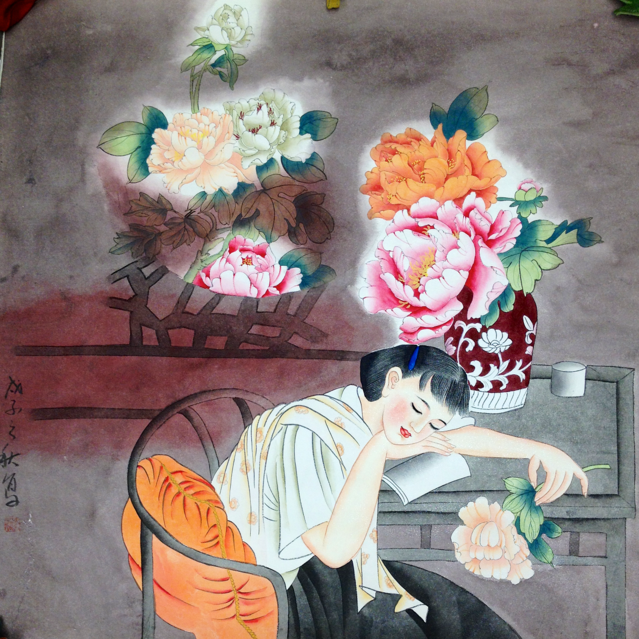
Visual artists have painted glorious images about dreams. These artists include Pablo Picasso, Henri Matisse, (1) Henri Rousseau (2) and many, many others, all of whom created a painting called The Dream. The images typically show a person sleeping in the foreground, presumably dreaming and at times, the rest of the image might represent the content of that person’s dream. Artists may also paint only the contents of a dream or nightmare (e.g. the fantastic jungle images of Rousseau.) Johannes Vermeer’s painting, A Maid Asleep, is gorgeous and has a prominent place on my book website.

How do you think about dreams, your’s other’s, and/or depictions of others? Like the wonderful diversity of dreams, there is a diversity in thinking about dreams. There may not be a right answer. Just as a therapist might try to tease the “meaning” and significance of a person’s description of a dream, one may try to understand an image about a dream. Following is an example based on the painting accompanying this blog post:

This painting is from a gallery which was part of an art school in Chongqing, China. The artist remains unknown despite contacts with the art school and artists in Chongqing and art experts in the US.Unknown artist

The picture shows so many wonderful aspects about sleep. It is a fluid story that tells us that before she fell asleep, the woman was reading and relaxed, admiring the peony in her hand (perhaps sent by a lover). The flower and the hand are dropping; she must now be in REM sleep (REM atonia). Her dream consists of images of peonies that are floating upwards from the real vase. The color of one of the flowers is the same as her cushion, which suggests a connection to reality. Daytime experiences can influence dreams (“Continuity hypothesis.”) (3) One can interpret or over-interpret such a picture and the dream. Freud interpreted a similar dream (From The Interpretation of Dreams, 1900, Chapter 6, Part 2, “The Dream-Work.”)

The Dream: “I arrange the center of a table with flowers for a birthday. On being questioned she states that in the dream she seemed to be at home (she has no home at the time) and experienced a feeling of happiness.”

The Interpretation: “The popular symbolism enables me to translate the dream for myself. It is the expression of her wish to be married. The table, with the flowers in the centre, is symbolic of herself and her genitals. She represents her future fulfilled, inasmuch as she is already occupied with the thoughts of the birth of a child, so the wedding has taken place long ago.”

I tend to seek a simpler interpretation of this work. It shows the beauty of sleep — and what can be better than a wonderful dream? We do not as yet know who painted this and we may never know. We do not know if the painter is a man or a woman. We do not know whether it is a self portrait and the painter is creating an image of herself, or whether the painter is the subject’s lover. The painter, whoever he or she is, beautifully expressed at once the beauty, complexity and simplicity of the dream. I wish I knew who painted this.*

Spending too much time on phones and tablets is like ‘digital heroin’ to kids

Staff Writer, Thai Tech

An expert in technology addiction has said that excessive use of smartphones and tablets is like “digital heroin” for kids.

Writing in the New York Daily Post, Dr Nicholas Kardaras explained how using technology such as tablets and phones raised dopamine levels, the hormone associated with rewards or feeling good.

Dr Kardaras added that research shows that the frontal cortex of the brain is affected by screens in the same way as it is affected when taking cocaine.

Citing Dr. Peter Whybrow, director of neuroscience at the University of California and Chinese researchers who each described screens as “electronic cocaine” or “digital heroin” to kids under 10 years of age.

Dr Kardaras says that once a child crossed the line of ‘tech addiction’ they become increasingly anxious, aggressive and depressed.

“It [tech addiction]can even lead to psychotic-like features where the video gamer loses touch with reality,” he said, adding that treatment can become difficult.

“I have found it easier to treat heroin and crystal meth addicts than lost-in-the-matrix video gamers or Facebook-dependent social media addicts,” Dr Kardaras said.

He adds that children need a full on digital detox, meaning no computers, smartphones, tablets and in some cases even television for a period of between 4 to 6 weeks in order for the child’s hyper aroused nervous system to reset itself.

Dr Kardaras tips for preventing tech addiction in kids is to play Lego rather than Minecraft, read books instead of play on the iPad or play sport instead of watching TV.

He also recommended having honest discussions with your kids about the amount of time they are allowed to use a smartphone or tablet and limiting such electronic devices at the dining table.

He adds that parents should really wait until a child is at least 10 years old before giving them a smartphone or tablet.

Unhealthy Diet during Pregnancy Ups Risk of Conduct Problems, ADHD

-Rick Nauert, PhD

New research from the U.K. suggests a high-fat, high-sugar diet during pregnancy may be linked to symptoms of ADHD in children who show conduct problems early in life.

Scientists from King’s College London and the University of Bristol explain that this is the first study to indicate that epigenetic changes evident at birth may explain the link between unhealthy diet, conduct problems and ADHD.

Epigenetic changes refer to environmental and other factors that may turn “on” or “off” particular genetic traits thereby influencing behavior or other characteristics.

The study appears in the Journal of Child Psychology and Psychiatry.

The finding is important as early onset conduct problems (e.g. lying, fighting) and attention-deficit/hyperactivity disorder (ADHD) are the leading causes of child mental health referrals.

These two disorders tend to occur together (more than 40 percent of children with a diagnosis of conduct disorder also have a diagnosis of ADHD) and can also be traced back to very similar prenatal experiences such as maternal distress or poor nutrition.

In this new study of participants from the Bristol-based
“Children of the 90s” cohort, 83 children with early-onset conduct problems were compared with 81 children who had low levels of conduct problems.

The researchers assessed how the mothers’ nutrition affected epigenetic changes (or DNA methylation) of IGF2, a gene involved in fetal development and the brain development of areas implicated in ADHD — the cerebellum and hippocampus.

Notably, DNA methylation of IGF2 had previously been found in children of mothers who were exposed to famine in the Netherlands during World War II.

Researchers found that poor prenatal nutrition, comprising high fat and sugar diets of processed food and confectionary, was associated with higher IGF2 methylation in children with early onset conduct problems and those with low conduct problems.

Higher IGF2 methylation was also associated with higher ADHD symptoms between the ages of seven and 13, but only for children who showed an early onset of conduct problems.

Dr Edward Barker from King’s College London said, “Our finding that poor prenatal nutrition was associated with higher IGF2 methylation highlights the critical importance of a healthy diet during pregnancy.

“These results suggest that promoting a healthy prenatal diet may ultimately lower ADHD symptoms and conduct problems in children. This is encouraging given that nutritional and epigenetic risk factors can be altered.”

Dr Barker added, “We now need to examine more specific types of nutrition. For example, the types of fats such as omega 3 fatty acids, from fish, walnuts, and chicken are extremely important for neural development.

“We already know that nutritional supplements for children can lead to lower ADHD and conduct problems, so it will be important for future research to examine the role of epigenetic changes in this process.”

Source: Kings College London